Arbitra Research - module available in the pilot
OHADA legal research, with a verifiable source for every answer.
Ask your question in plain language. Arbitra searches the uniform acts, CCJA case law and national decisions, then answers by citing the exact passage - document, page, extract - that you can open and verify before you use it.
« La caution solidaire ne se présume pas ; elle doit être expresse et ne se peut étendre au-delà des limites dans lesquelles elle a été contractée1. »
CCJA, 3e ch., 12 March 2024 - Ruling no. 047/2024, p. 14
The problem
OHADA law is harmonised. Access to it is not.
Scattered documentation
Statutes, uniform acts and decisions spread across heterogeneous sources, rarely centralised.
CCJA case law barely accessible
Thousands of rulings of the Common Court of Justice and Arbitration remain hard to find and hard to cite correctly.
General-purpose tools, badly calibrated
General-purpose assistants do not know the OHADA corpus and produce references that cannot be verified.
Non-billable search time
Finding, cross-checking and verifying a source consumes hours the firm does not bill.
How it works
Three steps, no untraceable source.
You ask the question in plain language
« Must a joint and several guarantee be express under OHADA law? » - no boolean operators, no syntax to learn.
Arbitra searches a controlled corpus
The search runs only on documents that have been ingested, classified and validated: uniform acts, CCJA rulings, national decisions.
The answer arrives cited and openable
Every statement carries a numbered reference. One click opens the exact passage in the source document, at the right page.
Preview
An answer and its sources, side by side.
The Arbitra Research answer screen always shows two things at once: what the engine asserts, and what it rests on.
Answer
Yes. A guarantee is not presumed: it must be express and its scope is assessed strictly within the limits agreed by the guarantor1. The Uniform Act organising securities requires a written instrument on pain of nullity, together with a handwritten statement of the maximum sum guaranteed2.
Joint liability in particular is not inferred from circumstances: absent an express stipulation, the guarantor keeps the benefit of discussion3.
Answer generated by artificial intelligence from the Arbitra corpus. Check every source before any professional use.
Interface preview - illustrative content, non-contractual.
What it changes
Less time searching, more time reasoning.
Preparatory research cut down
Finding the relevant texts and decisions takes one query, instead of a series of scattered lookups.
A citation that holds up
Every reference points to a document, a page and a precise extract - usable as it stands in an opinion or a pleading.
A corpus that stays current
New decisions and updated texts enter the corpus after review, with nothing for you to do.
The matter, not the tab
Searches, retained sources and notes file themselves by matter, available later without redoing the work.
A structured synthesis note
The elements you retain assemble into a reasoned note, each paragraph keeping the link to its source.
Wider access within the firm
Associates and trainees work on the same controlled corpus, with the same level of traceability.
The difference
Find a word, or find a source.
| Criterion | Keyword search | Arbitra Research |
|---|---|---|
| Wording | Exact terms, operators, successive attempts | A question in plain language, as you would put it to a colleague |
| Result | A list of documents to work through | A written answer, with the reasoning anchored in the texts |
| Verification | On the reader, document by document | A numbered reference opening the exact passage, page included |
| Links between sources | None: documents are returned in isolation | The text, the decision that interprets it and those that cite it are linked |
| Scope | Whatever the engine has indexed, with no guarantee of completeness | An OHADA corpus, bounded and checked before publication |
Reliability
The safeguards are not a product option.
No statement without a citation
A sentence produced by the engine with no source attached is not displayed. That is a product rule, not a setting.
Human validation before publication
A document only enters the searchable corpus after review by the legal team. The status « published » is a decision, never an automatic step.
Traceability down to the page
Every citation keeps the source document, the page and the position of the extract. Nothing rests on a paraphrase.
Your matters stay yours
The searches and documents you upload are not used to train any model. Processing complies with the GDPR, under a French publishing company.
Coverage
A country-by-country rollout, not a launch for show.
17
Member States of the OHADA area, one common body of business law
~400M
Inhabitants in the area covered by the OHADA treaty
3
Families of indexed sources: uniform acts, CCJA, national courts
Practising in a country not yet covered? Be notified of the launch in your jurisdiction.
Geographic coverage
A progressive rollout across the OHADA area.
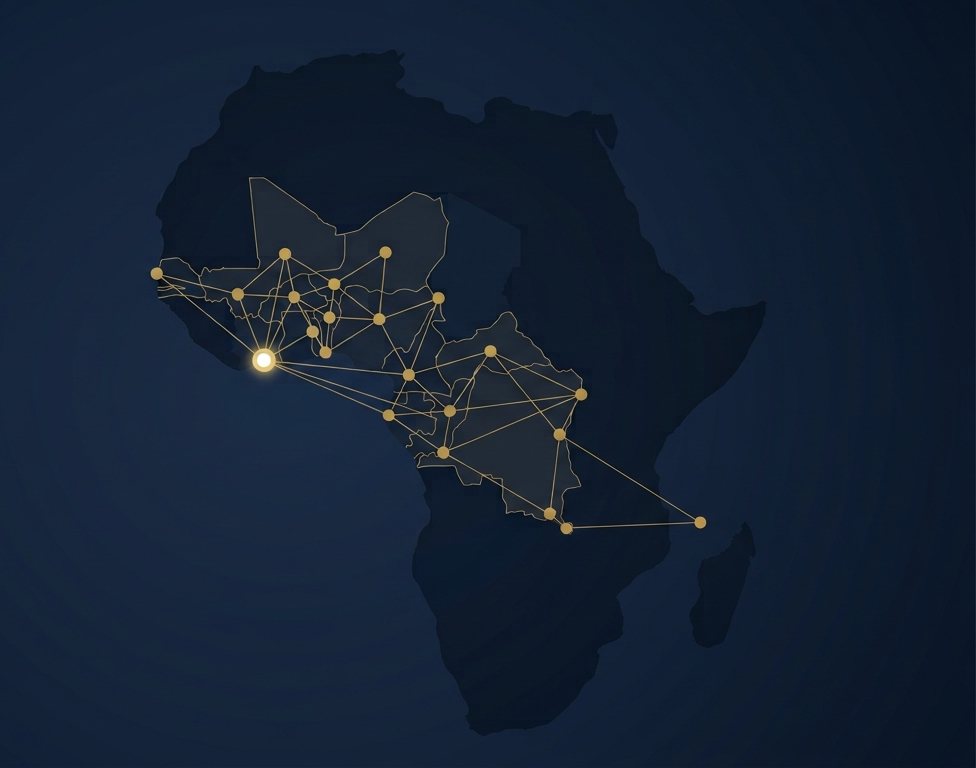
MVP - under way
Côte d'Ivoire
Pilot corpus and first lawyer users.
V1 - at 12 months
Regional extension
V2 - at 24 months
The 17 member States
Progressive rollout across the whole OHADA area, Comoros included.
The platform
Research today, four modules after that.
Arbitra Research is the module available in the pilot. The others are being built with feedback from the first user firms, not announced before they are ready.
Frequently asked questions
What firms ask us first.
What is OHADA law, and why a dedicated tool?
Which sources does Arbitra Research work on?
How can I be sure an answer is not invented?
Does Arbitra replace the lawyer's analysis?
Are my matters used to train your model?
Which countries are covered today?
How do I get access to the product?
See Arbitra on your own matters.
A 30-minute demonstration, on questions you bring. No commitment, and nothing to install.